

For businesses
The Referral Director: who governs your company's relational network
It's a new profession, not a sales role with a different desk. It doesn't sell: it opens doors and keeps alive the network that opens them. It sits inside the company, has a written mandate and training, and its work happens almost entirely in one block of time early in the morning.
- Born from the corollary of the Fourth Law
- Can be someone already on staff, even part-time
- In the measured cases, it was part-time in both companies
The difference in one line
The salesperson closes deals. The Referral Director makes sure someone opens them, and makes sure whoever opened them gets something worthwhile back.
They are two different jobs that coexist in the same company, and they're complementary: without the first, the channel doesn't convert; without the second, the channel doesn't exist.
Anyone who lands on this page searching for how to "hunt down clients" is looking for the role that chases. This one doesn't: it waits for someone trusted to open the door, and works to make sure that someone exists, is many, and stays.

01 Where it comes from
A law that described a problem, and a role that solves it
The Referral Director isn't a marketing idea: it's the operational corollary of one of the discipline's six laws, written because without that role the law described a promise that didn't hold up in practice.
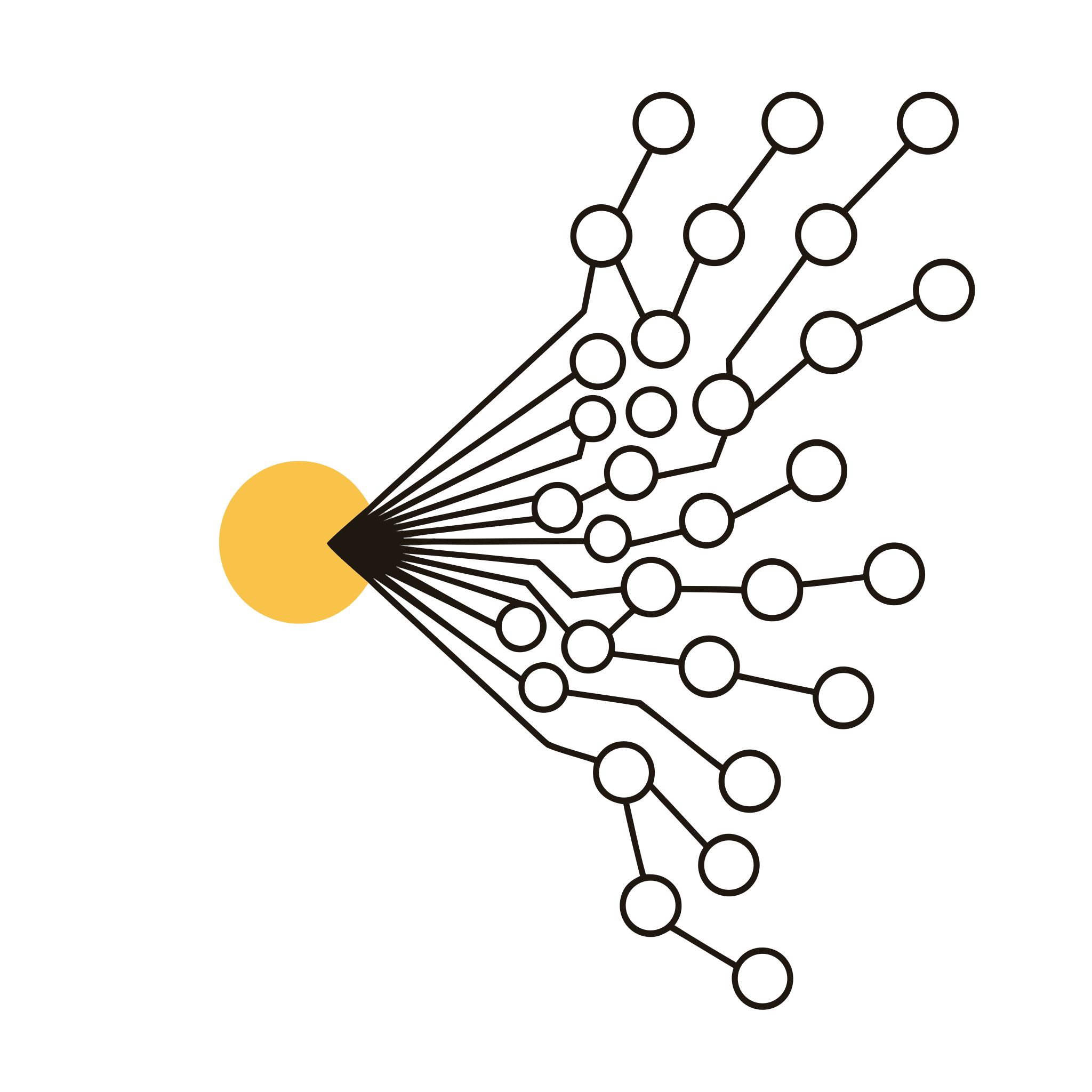
Fourth Law — the Law of Multiplication
Activating a person is addition. Activating an organization is multiplication, but the cost of activation grows with the complexity of the node: without a designated access point inside the organization, the promised multiplication is lost in the friction of internal process. The leverage is real only if someone, inside the node, has the mandate to make it happen.
The corollary, added after a senior Connector identified the asymmetry between potential leverage and real friction: the discipline never activates an organization in a vacuum — it pairs it with an internal role that has the mandate and training to make it move. The six laws.
What this means inside a company
Every company is a reservoir of dormant ties: customers, suppliers, partners, collaborators, each with their own network. When that reservoir switches on, it's not a person that moves, it's a structure — and that's where things jam.
Moving an organization is a process, not a conversation. It takes someone who, on Monday morning, has that process written into their own mandate — not filed under things to do "when there's time."
Without that person, the program doesn't start. That's why the Referral Director is decided during the kickoff day, not afterward: without a name in the box, nothing proceeds.
02 The job
What it actually does, and what it isn't
The most costly confusion is turning it into a salesperson with a new title. If that happens, within a month they're chasing deals and the network stops growing — and when the network stops growing, no other metric makes up for it.
| It isn't | It is |
|---|---|
| Another salesperson | The salesperson brings the deal home. The Referral Director makes sure the deal arrives already introduced. If you also give them sales targets, the relational part is the first thing to go. |
| A business finder | That role chases people who aren't expecting them and gets paid on results. Here, the job is to build and maintain a network of people who introduce the company because they gain in relationships, not just in money. |
| A Connector | The Connector is external: they put their own reputation on the line when they refer someone. The Referral Director is internal and governs the company's network of Connectors. Glossary. |
| An org-chart role | It's a mandate plus training. Without the mandate, it's a well-meaning person who can't decide anything; without the training, it's a person with the mandate who doesn't know what to do on Tuesday morning. |
-
Recruits
Finds Connectors and brings them into the Club: starting with who the company already has around it — customers, suppliers, professionals orbiting it — then widening outward. One metric rules over all the others: how many new partners joined this week.
-
Profiles and nurtures
Knows every Connector one by one — who they are, what they do, who they really know — and turns that into a priority order. Then keeps the relationship alive: it's the block of work almost no company has, and it's where most of the value dies when it's missing.
-
Guarantees the return
Makes sure whoever opened a door gets something back — in money, but above all in useful relationships, through Match Credit. It's the part the company can delegate, and it's what keeps the mechanism running after the first burst of enthusiasm.
03 The day
The work happens almost entirely before 10:30
This profession has one feature that makes it sustainable inside a company that already has a hundred things to do: it fits inside one bounded block of time, always the same one, always at the same hour.
The 10:30 rule
The routine starts at 8:30, before anything else. If it hasn't been completed by 10:30, the day is compromised. There are no exceptions and no afternoon catch-ups.
It's an end deadline, not a start one, and the difference isn't just formal: a routine started at 10:25 is a routine that didn't happen.
The math confirms it: the Referral Director's four blocks are exactly two hours, and 8:30 + 2h00 makes 10:30. The time wasn't chosen at random — it's the moment when the routine, started on time, ends.
The hunting happens in the morning, when energy is highest and people answer. The afternoon is farming: you cultivate what you sowed in the morning.
Two hours, plus twenty minutes you can delegate
The declared commitment is 2 hours and 20 minutes. Of these, exactly two hours belong to the Referral Director; the remaining twenty — the administrative part — are delegable to a second person, which is what happens in most companies.
And there's one thing that sits outside this count, and it's the most important: sales meetings with referred prospects are not part of this budget. They're the salespeople's work, like any other deal. The Referral Director opens the doors and passes the baton.
It's the answer to the objection that always comes up — "we don't have the time." The time required is a two-hour block in the morning, not one more full-time person.
The length of each block isn't the same for everyone: it comes out of the math of the kickoff day, which starts from the company's goal and works backward to how many conversations are needed each morning. How it's calculated.
| Block | Time | What happens |
|---|---|---|
| Dashboard | 10 min | The day's actions on the CRM, the referrals that came in overnight, MigaMATCH notifications. No email in this block. |
| Hunting and Club | 60 min | Three new conversations a day, twenty minutes each. You propose the Club, explain the mechanism, and ask for sign-up by sending the link while still on the phone. |
| Follow-up | 25 min | Callbacks to people who said "I'll think about it," and collecting the three names. The cadence is fixed: at 7 days, then 5, then three months of nurturing. It's the block almost no company has, and it's where the value dies when it's missing. |
| Collection | 25 min | Appointments generated from referrals received, and coordination with the sales team for demonstrations. |
| Referral Director total | 2h 00 | From 8:30 to 10:30. Sales meetings with referred prospects are not part of this budget: they're the salespeople's work. |
| Admin (delegable) | 20 min | Club sign-ups on the APP PRM and the CRM, tomorrow's action list, moving referrals along and commission credits. In this example, a second person handles it, and that's what brings the total commitment to 2h20. |
The tool that keeps the pace
The Dashboard and Admin parts of this routine live on the APP PRM: it's not one more piece of software to learn, it's the layer that measures every conversation, every referral, every acknowledgment, and gives the Referral Director the pace to keep — a bit like a coach who counts the laps and says when to accelerate.
It's closed, carries your company's brand, and every referral that passes through it is notarized on blockchain.

The Stoic method, which is the uncomfortable part
"We're not asking you for €150,000. We're asking you for 2 hours and 20 minutes a day. For 12 months. The result is math, not hope."
The inputs depend on the Referral Director: how many new conversations, how many follow-ups, how many sign-ups formalized. The outputs are a consequence: valid referrals, meetings set, deals.
Which gives the rule that makes every argument pointless: if the inputs were met and the outputs are low, the problem is one of quality — script, targeting, offer — and it gets fixed. If the inputs weren't met, the system wasn't fed, and there's nothing to analyze.
Four numbers, counted every Friday
All the initial analysis converges into a handful of weekly actions, always the same ones. The numbers are four, they fit on a single sheet, and you count them with a pen.
There's no fifth number, and that's deliberate: a dashboard with fifteen indicators is a dashboard nobody looks at, and a person who has to choose among fifteen priorities at 8:30 in the morning ends up doing none of them.
One definition that's worth more than many instructions: a referral is valid only if the Connector spoke in person with someone and that someone said yes to being contacted. A name picked up cold isn't a referral.
04 If you already have a sales network
It doesn't replace your agents. It coordinates, and they execute
It's the most concrete question we get asked: "what's the relationship between the Referral Director and my forty agents?" The short answer is that they don't overlap — one works on the doors, the others on what's behind the door.

Your problem isn't closing: it's getting in
A company with a sales network has already solved distribution: it has people paid to be in front of someone, and it knows how to close clients. What it's missing are the doors.
And there's a constraint nobody states out loud: advertising isn't just there to generate opportunities, it's there to fill the calendar. That's the promise that holds the network together. That's why it can't be switched off, and why hunting can't be replaced — only supplemented.

What changes in the agent's month
Before: 25 cold leads a month, every one opened from scratch.
After: 20 cold leads plus 3 people to meet, selected by AIRA© in the right supply chain, who already have among their own clients the ones the agent is looking for.
Those three people are not leads to be worked. They're people the agent doesn't have to sell anything to, and that's exactly why they work: an agent who treats them as a sales opportunity burns them at the first meeting. The Referral Director is the one who explains this and makes sure it happens.
A worked example, stated as such
Forty agents, three meetings each per month: 120 meetings a month in the field, with people who already have the clients you're looking for.
Who are these people, in practice? It depends on the supply chain. For a general contractor, they're typically architects, surveyors, engineers and tradespeople: professionals who are the first to see who's about to build or renovate, before the market knows.
It's arithmetic, not someone's actual result: it hasn't happened to any specific company and we're not writing it as if it had. It's only there to show the order of magnitude we're talking about when you multiply it by the number of people you already have in the field.

Where the difference lies, without numbers
Hunting starts over from zero on the first of every month. Sowing doesn't. A spent cold lead is spent; a professional who's opened one door for you can open others for years.
It's the same mechanism as compound interest: sowing multiplies with every month that passes, instead of starting over. That's why a few good contacts are enough, against the twenty-five leads hunting has to find from scratch every month.
It's the difference between a cost and an asset, and the agent doesn't change job: they keep hunting for most of their time. What changes is that every month they leave behind something that's still there the next month.
The starting recommendation is to shift 20% of the budget from hunting to sowing, keeping the 80% where it is. It's a budget split and nothing else: the agent's agenda is counted in people, not percentages.
05 The person
It's almost always already on staff, and almost always part-time
In the two cases we measured in full, no new person was hired: people who were already there were identified, and given a mandate, training, and a protected block of time.
3
Part-time Referral Directors at Ital Tetti, one province each
September 2021 – September 2022 · a company of about thirty employees · the full case
1
A single part-time Referral Director at Uniac, across ten locations
November 2022 – January 2023 · the full case
15 min
Average time to profile a Connector on the phone
Method observed in both cases · one conversation to understand who the person is, and therefore who they know
The Brain and the Engine
During the kickoff day there's a block whose only purpose is this: figuring out who in the company is the Brain — who designs, decides and holds the course — and who is the Engine, meaning who actually picks up the phone at 8:30 in the morning.
They can be the same person or two different people. What can't happen is for it to be nobody, or "a bit of everyone."
The question asked in that block, without dancing around it: how would you react to a block of phone calls every morning for two months straight? The answer says more than any résumé.
What's actually needed
The requirement that surprises business owners is the third one. If the Referral Director also has a sales budget to hit, at the end of the month they'll choose the open deal over the relationship to nurture — every time, and for good reason.

Better junior than technical
You don't need the most experienced person in the company, and choosing them is often counterproductive: someone with a technical profile tends to explain how a problem gets solved, while a Connector needs to understand which problem you solve and who you're looking for. They're two different skills, and the second isn't inherited from the first.
What really matters is empathy and the drive to grow: someone who sees in this role the chance to become one of the most influential figures in the company — the owner's right hand — with a career that can accelerate far faster than the traditional path.
06 The certification
There's a public register of Referral Directors
The profession has its own professional register, and that's not a metaphor: it's a register kept by E.S.S.E. Ingegneria delle Relazioni, a professional and training association established under Law 4/2013, the Italian law on professions not organized into orders or colleges.
What it takes to be on it
There are two requirements, and neither is met with an afternoon of classroom time:
The qualifying course is joined by proof in the field: six months of actual work at a company, certified by the company itself. Plus a self-declaration on legal age, professional good standing, criminal record and adherence to the association's code of ethics.
The register has two sections; this page concerns the Referral Directors one.
Two things to know before looking it up
The register's website states that it's under construction. The regulations and requirements exist and are the ones above; public browsing of registered members isn't open yet. Cost of registering: €99. The 20-hour qualifying course is delivered by the same E.S.S.E. Ingegneria delle Relazioni (opens in a new tab) that keeps the register.
And the president of the association is Oscar Dalvit, who is also the founder of Segnalazione Vincente. We're saying it before anyone else finds out: a discipline founding its own professional association is normal — it's happened with every new profession — but it is not a third-party body, and calling it that would be dishonest.
Meanwhile, inside the company
Operational training doesn't wait for the register, because it's built into the program: the designated Referral Director takes part in the kickoff day, where their company's relational architecture is built, comes out with their own routine and their own four numbers, and is followed for the following three months with weekly and monthly reviews.
The two things are sequential, not alternatives: the program provides the hours in the field, the register recognizes them. The scripts, thresholds and priorities of a network of accountants aren't the same as those of a network of installers — you learn on your own case, with your own numbers.
Why a register changes things
A profession truly exists when someone can be excluded from doing it. A list with entry requirements, six months of proof in the field and a code of ethics is exactly that: the point where "Referral Director" stops being a title anyone can print on a business card.
It's also why the requirements call for six months in a company and not just twenty hours of classroom time. This job isn't proven with an attendance certificate: it's proven with a network that has actually moved.
Frequently asked questions
The six we always get asked
Do I need to hire someone new?
Almost never. In the cases we measured in full, the Referral Director was someone already at the company, part-time on this function. What needs to be created isn't a position: it's a mandate and a protected block of time.
Can the owner do it?
Yes, and it often happens at first. The risk is well known: the owner is the person whose calendar is most exposed to the unexpected, and so is the first to skip the morning routine. If the owner holds the role, the 10:30 rule needs to be defended by someone else.
What's its relationship with my agents?
It doesn't replace them and doesn't work alongside them in the field: it coordinates the channel, and the agents execute. The Referral Director builds and maintains the network of people who open the doors; the agent walks through those doors and does the job they know how to do. Above there's a section dedicated to companies that already have a sales force.
How much time does it really take?
The declared commitment is 2 hours and 20 minutes a day, of which two hours belong to the Referral Director and twenty minutes are administrative and delegable. The block runs from 8:30 to 10:30, every working day.
Sales meetings with referred prospects fall outside this count and remain the salespeople's work: it's the difference between asking for one more full-time person and asking for two hours in the morning.
The exact minutes of each block come out of the kickoff math, because they depend on how many conversations your company's goal requires. What doesn't change is the order and the time it ends.
Is the title recognized by anyone?
There's a public register of Referral Directors, kept by a professional association established under Law 4/2013. Getting on it takes a qualifying course of at least twenty hours with a competency assessment and six months of on-the-job placement certified by the company.
Two clarifications we'd rather make ourselves: the register's website is openly under construction, and the president of the association is the founder of Segnalazione Vincente. It is not a third-party body and we don't present it as one.
What if the person leaves?
It's the real risk of this model, and we don't hide it. It's reduced in two ways: by keeping the network and its data inside the company's own systems — the APP and the CRM belong to the company, not to us and not to the person — and by not concentrating the whole network on a single point of contact when the company is big enough to afford two, as happened in the case where there were three Referral Directors, one per province.
The first step
Does your company really need this role?
AIRA-SCAN© starts answering in three minutes: among the ten questions there's one that asks whether someone has the mandate to govern relationships, and the answer feeds into the Relational Potential Index it gives you back.
Then the extended report arrives by email and within one working day someone calls you: you look at the result together and assess whether the AIRA-DX© Stoic Analysis makes sense for your company. It's free and limited to twelve a week, so it isn't owed to whoever does the check-up: it's decided together.
Who, in your company, could hold the role — and how much time they actually have — is one of the things the analysis measures. Would you rather just talk about it? The number is 0549 888808.