

Blog · Sphere of influence
The power of a Referral Director's business influence
Every person who works at your company brings with them a network of relationships the company has never counted. Added together, they're the biggest thing you own and the one you know least about. This article tries to put a number on it — and to say who, inside the company, should be in charge of it.
Published 9 October 2021 · revised 16 August 2026
The starting point
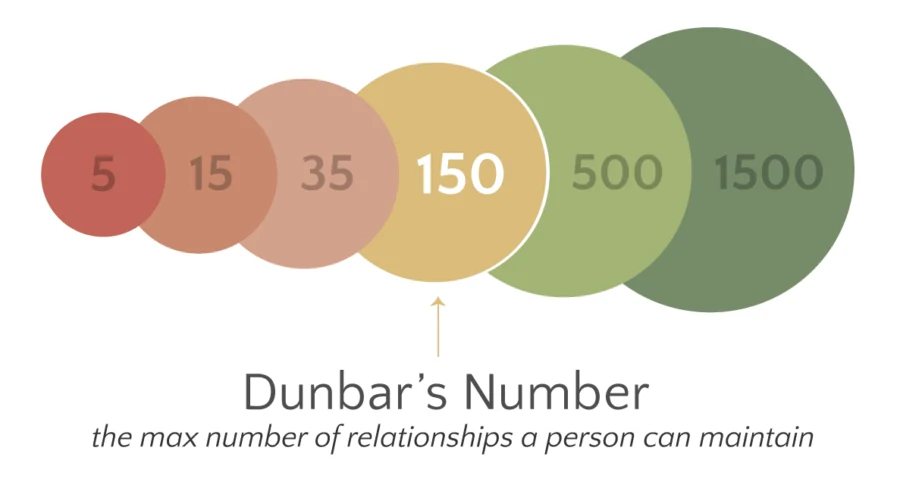
Dunbar's number
It is the quantification of a cognitive limit: the number of people an individual can maintain stable social relationships with — relationships in which they know each person's identity and how those people relate to one another. On average, about 150.
The figure comes from the studies of anthropologist Robin Dunbar and is one of the few numbers in this field that comes from real research rather than an industry report.
Around 150 sit other thresholds: the 5 closest ties, the 15, the 35, and further out the 500 and 1,500 faces recognised without being known.
What it's useful for
Four questions almost no company has ever asked itself
They aren't rhetorical: if you have even an approximate answer to all four, you're already ahead of the competition.
-
What is your company's sphere of influence?
Not yours: the sum of everyone who orbits it, inside and outside the company.
-
How much does it vary from job to job?
A sales agent and a factory worker don't know the same number of people, and above all they don't know the same people.
-
What are the occasions for contact?
A parent at a school meeting crosses paths with about twenty families. It's an occasion, and nobody has ever called it that.
-
How many of those relationships are useful to your business?
This is the question that turns a big number into a useful one. Without it, the sphere of influence stays an anecdote.
The 2021 article added here that "99.9% of companies don't even know what the area of influence is". It's a figure nobody ever measured, and that's why it's gone: the substance — that almost nobody knows — holds up just as well without pretending to be data.
One word at a time
Who handles all this, inside a company
This 2021 article is the only one in the batch that already names the right role. What was then an intuition is today a profession with a career path.
The 2021 question
"If your purchasing department came across a sales agent with five hundred contacts, is it trained to propose working together?" And the worker who meets a potential customer at a school party: has anyone ever explained to them what to do?
In almost every case the answer is no. Not out of ill will: because there's nobody whose job it is to handle it.
The answer, today
That job is the Referral Director: a role inside the company, trained, with an explicit mandate. They don't sell — they govern the company's relational network, keep the routine and read the numbers.
And there's a law that explains why it doesn't work without them: activating one person is an addition, activating an organisation is a multiplication, but only if someone inside the organisation is designated to receive it. Otherwise the leverage is lost in internal friction — Fourth law.
The asset they govern also has a name: Relational Capital.
Everyone has the mine. What's almost always missing is someone to go down into it.
The first step
Where your company stands, with a number
AIRA-SCAN© measures the Relational Capital your company already has: ten questions, three minutes, no sign-up. Your browser calculates the score and it appears immediately, with the areas where you're losing the most points.
The extended report then arrives by email and within one working day a person calls you: you look at the result together and assess whether the Stoic Analysis AIRA-DX© makes sense for your company. It's free and limited to twelve a week, so it isn't owed to whoever takes the check-up: it's decided together.
Prefer just to talk? The number is 0549 888808.